

Luca Resti (PhD Researcher)
Researcher in Acoustic Signal Processing
Site Design
#03a9f4
#009688
#FFC107
Description
I am Luca Resti, a PhD candidate at the University of York, UK.
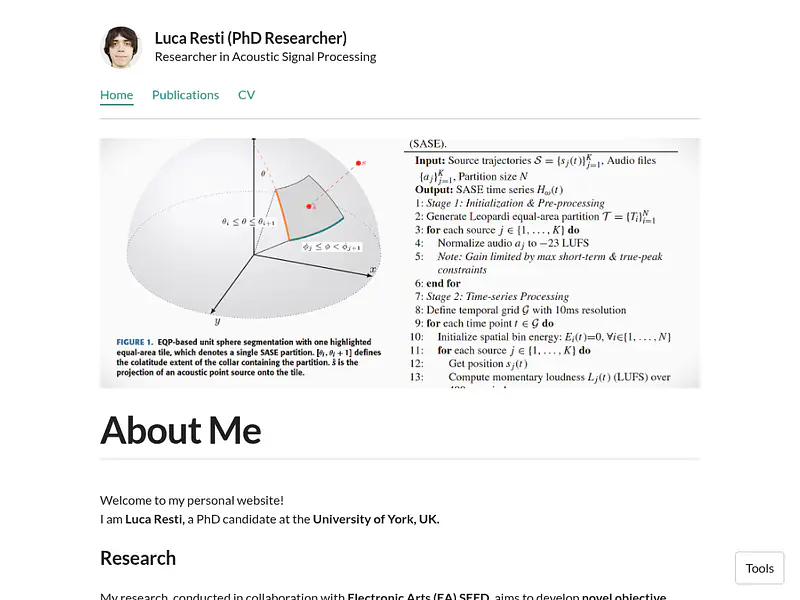
My research, conducted in collaboration with Electronic Arts (EA) SEED, aims to develop novel objective audio-visual signal quality assessment methodologies to support the quality assurance process for developers of interactive multimedia applications. As part of my PhD, I have developed SASE – a perceptually-weighted, intrusive metric for estimating acoustic scene complexity in channel-based audio – MAV-C – an audio-visual extension of SASE – and SHADE – a non-intrusive diffuseness estimator for ambisonic audio signals (IEEE TASLP submission in progress).
I have also won EPSRC IAA funding for a project titled XSQ-AST: An Explainable Audio Spectrogram Transformer Framework for Localising Synthetic Speech Artifacts. This project – in collaboration with EA SEED – resulted in a paper and a publicly available tool for localizing quality artifacts in synthetic speech.
I obtained my BSc in Engineering of Computing Systems at Politecnico di Milano, Italy, and my MSc in Information and Communications Engineering at FAU Erlangen-Nürnberg, Germany. I was previously a research associate at the Fraunhofer Institute for Integrated Circuits IIS, where I worked on the development of the next-generation MPEG-H audio format, and researched the application of intelligibility metrics for predicting preferred speech-to-background loudness differences in source-separated audio.
Recent Updates
MAV-C: A Framework for the Joint Objective Estimation of Audio-Visual Complexity in Immersive Virtual Environments
Abstract We present the Motion-Aware Audio-Visual Complexity Metric (MAV-C), a reference-free framework for the joint objective estimat...
Spherical Acoustic Spatial Entropy: Predicting Acoustic Scene Complexity in Virtual Environments
Abstract The objective quantification of Acoustic Scene Complexity (ASC) remains a significant challenge. While existing entropy-based ...